Archive | Nice RSS feed for this section

Restaurant review: Restaurant d’Angleterre, Nice

14 Oct

Restaurant d’Angleterre, unbeatable value for money for traditional French food in central Nice

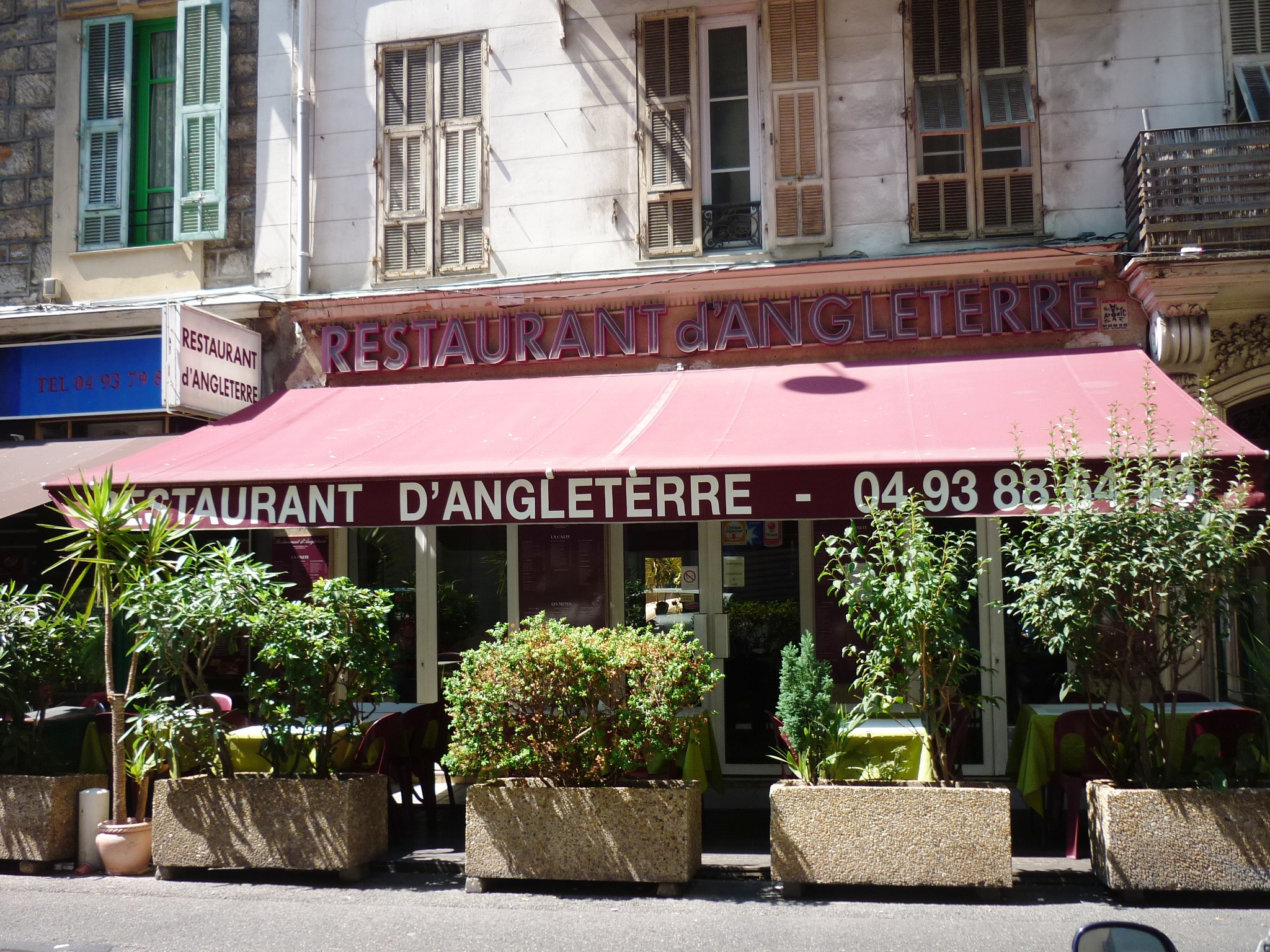
For the first individual restaurant review on the blog, what better choice than one of my favourites in Nice for traditional French cuisine, the Restaurant d’Angleterre. This small, family-run place is absolutely unbeatable in terms of value for money, quality of food and service and when I was running my hotel, just a few minutes away, this is where I sent my clients who asked for a good recommendation – none of them never came back disappointed.

Located on rue d’Angleterre, close to avenue Jean Médecin and to the train station, behind Notre Dame Basilica, the neighbourhood is very uninspiring and rather grotty but don’t let that dissuade you.

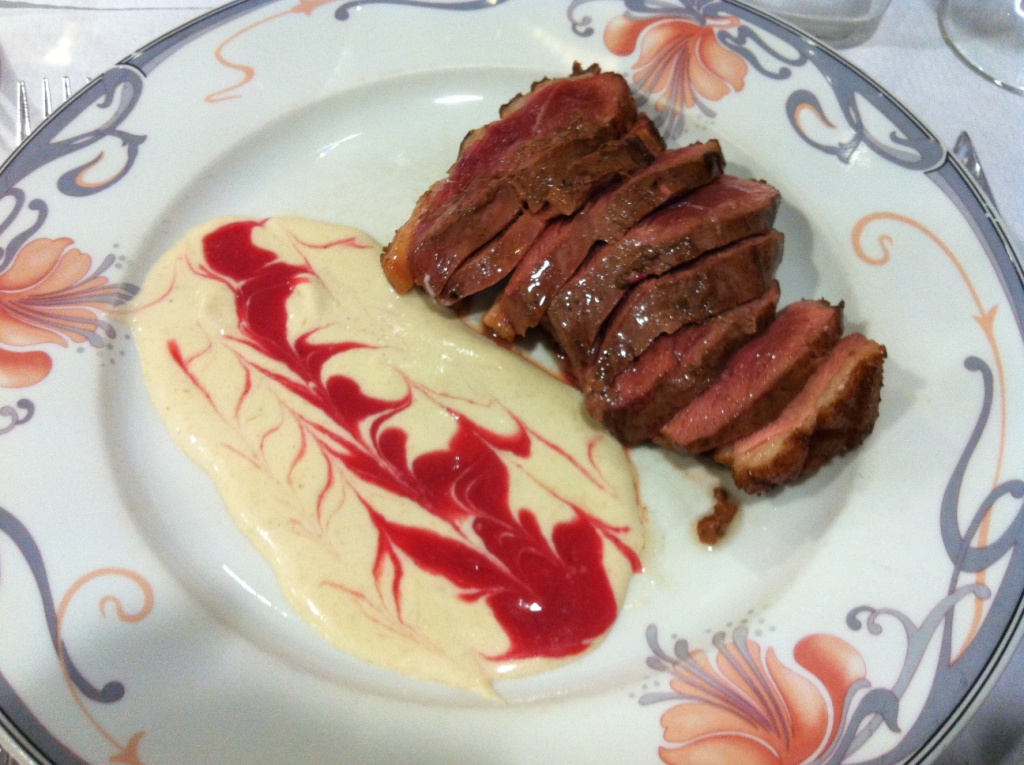
The entry-level menu of 16.50€ is already great value with three very filling courses that change every day. On a recent visit, this involved delicious salmon ravioli, followed by duck breast with mushroom and redcurrant sauce then a mango and strawberry pastry, there are in general 12 different dishes that you can choose from. There are also some excellent menus at 26.50€ and 31€, including foie gras, south-western salads (involving plenty of duck) and other delicious French specialities. Naturally, all the classics, like steak tartare, are executed to perfection.

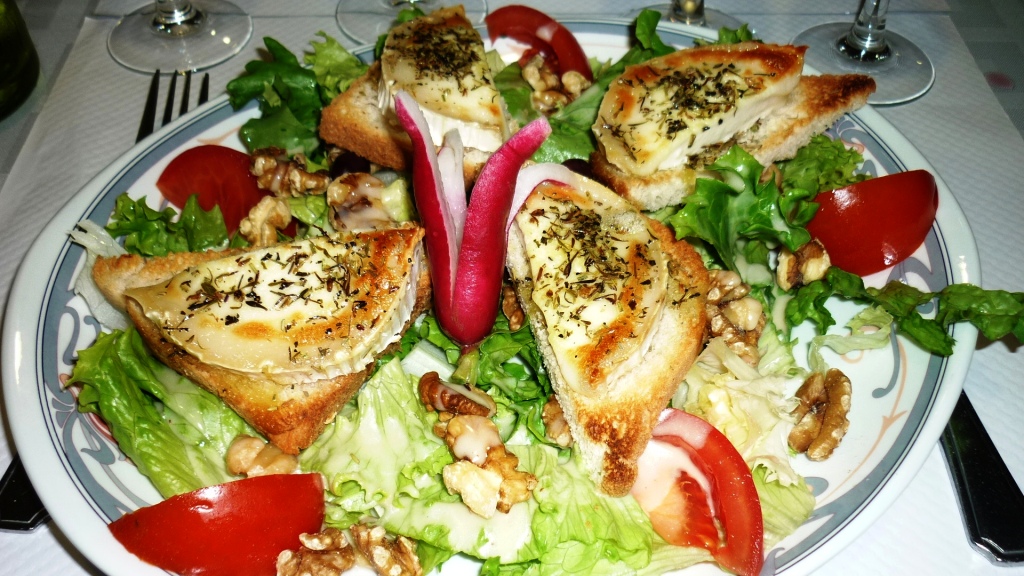
Starter of a warm goat cheese salad on toast, a French classic

Main course duck breast done just right with mushroom and redcurrant sauce, part of the 16.50€ three-course menu, great flavour and unbeatable value!

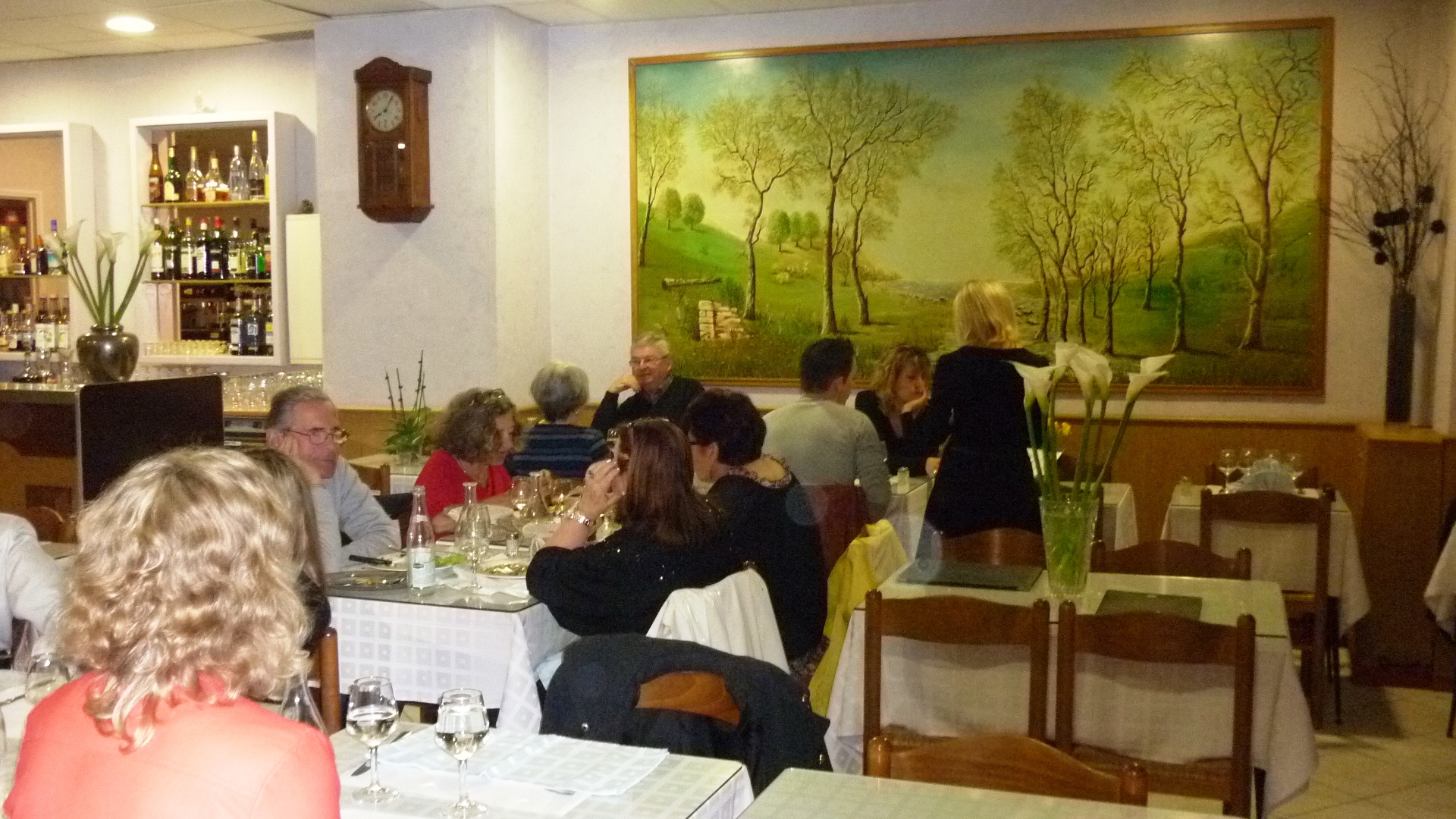
The decor is pretty unassuming but the place is full of locals and is run by a charming family: incidentally, the Tripadvisor reviews of the place don’t lie (apart from the person who was complaining that the portions were too big, which is true, but hardly something that warrants complaints). In any case, as I mentioned, one of the best addresses in Nice and strongly recommended so do not hesitate.

This restaurant ticks all the boxes for a quality meal on the Riviera: minimal investment in decor, family-run and full of locals, all recipes for a good address!

Restaurant d’Angleterre, 25 rue d’Angleterre, Nice, 0033 4 93 88 64 49. Closed on Sunday evenings and Mondays, annual holidays mid-November to mid-December.

A walking tour around the Old Town of Nice and restaurant guide

24 Mar

Global view of Old Nice from the Bellanda Tower on Castle Hill, you can see Cours Saleya on the left, running parallel to the waterfront

The Old Town of Nice (or Vieux Nice as the locals call it) is one of the city’s main attractions and a must-see for any visitor… Not particularly because of a huge amount of unmissable historical sites, but because it is a hive of activity, buzzing both day and night, which is ideal to wander around, to get lost in and to get a drink or a good traditional meal whilst enjoying the unmistakable baroque Mediterranean vibe. So here’s a quick walking tour to make sure you don’t miss any of the nicest parts, even though I’d advise the most adventurous to just get lost in the meander of streets and follow your instincts to make the most of the place – after all, it’s too small to get really lost and the sea is never too far away!

The triangle-shaped Old Town is surrounded by the Paillon river valley to the north (the river is buried underground but on top the local authorities are currently planting a very attractive new garden called the “coulee verte” which will be ready by 2013), by the Castle Hill to the east and the Mediterranean Sea to the south, just across the Quai des Etats Unis.

-          Starting from Place Massena, just take the pleasant rue St François de Paule, which is lined with some classy shops with the beautiful Belle Epoque Opera of Nice on the right.

The picturesque rue St François de Paule, linking Place Massena to Cours Saleya

One of my favourite shops in Old Nice in terms of decoration, the wonderful Auer chocolate and sweet shop on rue St François de Paule, dating from 1820 when Napoleon was still alive: the inside is still decorated in pure 19th century style.

Just after the opera on the left, you will get a glimpse of the large Palace Square (referring to the rather bulky and unattractive Palace of Justice/law courts) which has some terraces but isn’t the most pleasant part of the Old Town to stop over in, so just keep going straight down the road until you hit the pedestrian area where the street becomes the “Cours Saleya”.

-          The Cours Saleya (or “Corso” in the local Nissart dialect – all the streets names in the Old Town are both in French and Nissart), running parallel to the sea, is one of the liveliest streets of Old Nice.

The Cours Saleya looking eastwards towards the Castle Hill

In the morning, the central part of the street becomes a market: mainly for flowers but also for jumble sales or fruits and vegetables depending on the days. The strip is also lined with plenty of restaurants which are reasonably priced but varying in quality, so be wary, though the appeal of people-watching and soaking in the incomparable Mediterranean atmosphere can just about justify paying slightly more than elsewhere for a coffee or a quick meal. It’s also a great place to grab a portion of socca at Chez Theresa (see below in the food section) if she’s around.

-          Once you get to the end of the Cours Saleya, you can either turn right and head towards the waterfront and enjoy some sumptuous views over the whole Baie des Anges from the Castle Hill, or else carry on the tour of the Old Town and go left. Running parallel to Cours Saleya is the rue de la Préfecture which heads back towards Place du Palais and comes to life in the early evenings at around 5 or 6pm, which is aperitif time in Nice. The street is lined with bars (mainly English-style pubs or more upmarket lounges) and some pretty decent restaurants.

-          North of the rue de la Préfecture, towards the top end of the triangle, the streets get narrower as cars are banned and this is the ideal place to just wander around the area up to Place Garibaldi to the north.

The narrow alleyways with great natural ventilation north of rue de la Préfecture

This area is full of bars and restaurants, especially the southern end, around Place Rossetti, which is another of the nerve centres of the Old Town and an ideal place to just sit down and have a drink on a terrace, under the shade of the beautiful baroque Cathédrale Sainte Réparate, built in the late 17th century.

The baroque Cathédrale Ste Réparate on Place Rossetti

Place Rossetti, a perfect place to chill-out with a coffee and an ice cream

It is also a perfect place to have an ice cream at the famous Fenocchio parlour, see the description below. You’ll note that Old Nice is very cool, even in the heat of the summer – this is because of the shade and the very ingenious natural ventilation system devised by the locals when they designed the houses and alleyways hundreds of years ago.

-          As you head north of Place Rossetti, towards Place Garibaldi, the roads get slightly less lively and a bit more downmarket (plenty of kebab and fast food shops) but there are a few excellent restaurants.

The quieter alleways between Place Rossetti and Place Garibaldi

Also, make sure you visit the fish market (marché aux poissons) that is open every morning except Mondays until about 1.30pm on Place Saint François. Just bear in mind when walking round Old Nice that it’s not just a tourist area but also a prime residential neighbourhood – plenty of expats and locals live there due to its central location, mainly the younger ones given that most buildings are 4 or 5 stories high and don’t have lifts. This explains why there are plenty of grocery stores and regular shops catering for the locals, especially in this part of the neighbourhood.

A beautiful old bakery in Old Nice with wood-fired oven

-          Once you’ve reached Place Garibaldi (recently renovated in honour of the Italian freedom fighter), you can either walk towards the port, 5 minutes away, or head up the Castle Hill for some stunning views over Old Nice and the rest of the city and region – for more tips on how to enjoy your stay in the city, see my article Nice in a nutshell. For those leaving Nice by train, take the tram back towards avenue Jean Medecin and the railway station and for those taking the interurban buses, just saunter down Boulevard Jean Jaurès to the bus stop to head towards Monaco or Cannes.

Where and what to eat and drink?

-          A trip to Old Nice cannot be complete without sampling the main local dish, socca. This is a delicious pancake made of chick pea flour, water and olive oil and baked on a very wide cast iron pan – you can also find it on the Italian side of the border where it is known as farinata.

A typical plate of socca being prepared and cut up after baking (photo courtesy of http://www.annmah.net)

Portions generally tend to be reasonably priced: the big pancake is cut up into little strips and covered in black pepper, then eaten with the fingers (careful, the strips can be very hot if they are served straight out of the oven, as they should be). If you want to find out more about this delicious speciality, the New York Times ran an interesting article with an easy recipe (as long as you have easy access to chick pea flour) a few years ago.  Amongst the best places to sample it is Lou Pilha Leva, located on a small square at 10 rue du Collet, not too far from Place Rossetti (I just noticed it had rotten reviews on Tripadvisor, but I personally like it so I’ll stand by my selection – if you try it out and disagree, please let me know!).

Eating socca al fresco at Lou Pilha Leva

The place is pretty rustic, as you eat on benches outdoors, but the socca is very good and reasonably priced at 2.80€ a portion so ideal for a quick snack lunch whilst exploring the Old Town – they also serve some more elaborate typical dishes like petits farcis niçois (vegetables, generally onions, tomatoes and courgettes stuffed with meat) and pasta with daube (beef stewed in red wine with mushrooms) sauce. There is also another place recommended for its socca called Chez Theresa on the Cours Saleya. I’ve never tried eating there but this video will give you a good idea of the atmosphere on the Cours Saleya in summer!

-          If you want to stick to typical Niçois cuisine but with a sit-down meal, there is a multitude of places to choose from in Old Nice. My general rule of thumb would be to try to get a glimpse of the waiters and the chefs: the older they are, generally the better the food is – normally because the business is family owned and run. The same applies to the decoration – the good addresses don’t need fancy furniture to attract clients as long the food is good – and whether the place is packed with older locals or just tourists! My personal favourite for the moment is L’Escalinada, located slightly off the beaten track near Place Garibaldi at 22 rue Pairolière, with great specialities in a friendly atmosphere, you can find the whole menu on their website. Also highly recommended for their great value for money and typical dishes are Chez Acchiardo (38, rue Droite), Restaurant da Gesu (1, Place du Jésus), le Bistro d’Antoine (27, rue de la Préfecture) and la Merenda (rue Raoul Bosio).

-          A decent place I recently tried, if you want something a bit different from Niçois cuisine, is La Villa (14, rue de l’Abbaye), which specialises in Corsican dishes. I stumbled on this restaurant by accident a few months ago and had a truly excellent meal at a reasonable price, so I can definitely recommend it.

-          No trip to Old Nice would be complete without a visit to the famous Fenocchio ice cream parlour located on Place Rossetti. There is always a big queue due to the quality of its Italian style ice cream and the huge selection of flavours, including some rather exotic ones that you can’t really find elsewhere, like tomato and basil, violets or chilli. But the traditional flavours are just as good! There is also another shop at 6, rue de la Poissonnerie, close to the eastern end of Cours Saleya but note that they only open from March to November.

The delicious Fenocchio ice cream parlour on Place Rossetti

-          Finally, if you want to get a drink, there are plenty of English or Irish style pubs and more continental lounge bars in the Old Town, most offering happy hour prices around aperitif time (generally from 5/6pm to 8pm) – most of these are located on Cours Saleya or rue de la Préfecture, but there are also quite a few in the streets around Place Rossetti. Just be wary late at night as there tend to be more and more fights around closing time on weekends, especially in summer (at around 2 or 3am) and generally avoid the darker streets of the Old Town, even though Nice at night is no dodgier than other any large French city.

If you find any other good addresses in Old Nice, I’ll be happy to test them out – please let me know in the comments section below. Same applies if you have any feedback on the places I recommended, I’d love to hear from you.

Getting there

  • From the Nice Ville train station: either walk about 20 minutes down avenue Jean Medecin through Place Massena or else take a short tram ride (1€)
  • From the bus stops, arriving from Cannes (to the west) or Menton/Monaco (to the east): until the completion of the new bus station in 2016, most buses will terminate. near avenue Felix Faure: just cross over the large esplanade and you’ll be in the Old Town, you can’t really miss the spires of the churches when you get off the bus!

Essential Nice: exploring the capital of the French Riviera

20 Mar

The city of Nice, lying directly on the Mediterranean Sea

Most visitors to the French Riviera will pass through Nice at one point or another, given its central location, the fact that it is by far the largest city of the region and its role as the main transportation hub of the region. But Nice is far more than just a transit zone, it’s honestly a very beautiful city which is well worth spending at least a day visiting.

Most of Nice’s particular charm and character comes from the Italian feel of the city, which only joined France in 1860 after a long spell as part of various Italian kingdoms. In fact, the Italian freedom fighter, Giuseppe Garibaldi, was born in Nice in 1807 and there is still a statue of him in one of the central squares. Greece and especially Ancient Rome also had a strong influence in its history

For those with just a day to visit Nice, here are some of the main attractions of the city in a nutshell:

-          From the train station, just turn left to quickly avoid the seedy surroundings that are typical of train stations all over the world and you will soon get to Avenue Jean Medecin, which is the main shopping street of Nice and which, since 2008 and the launch of the Nice tram, has become a pedestrian area.

Avenue Jean Medecin, the main shopping thoroughfare of Nice

On the avenue, heading down on your right, you will notice the immaculately white (and formerly dark grey) Notre Dame Basilica, which is the largest religious edifice in the city and just got a long overdue spring cleaning of its facade.

The newly-cleaned Notre Dame Basilica

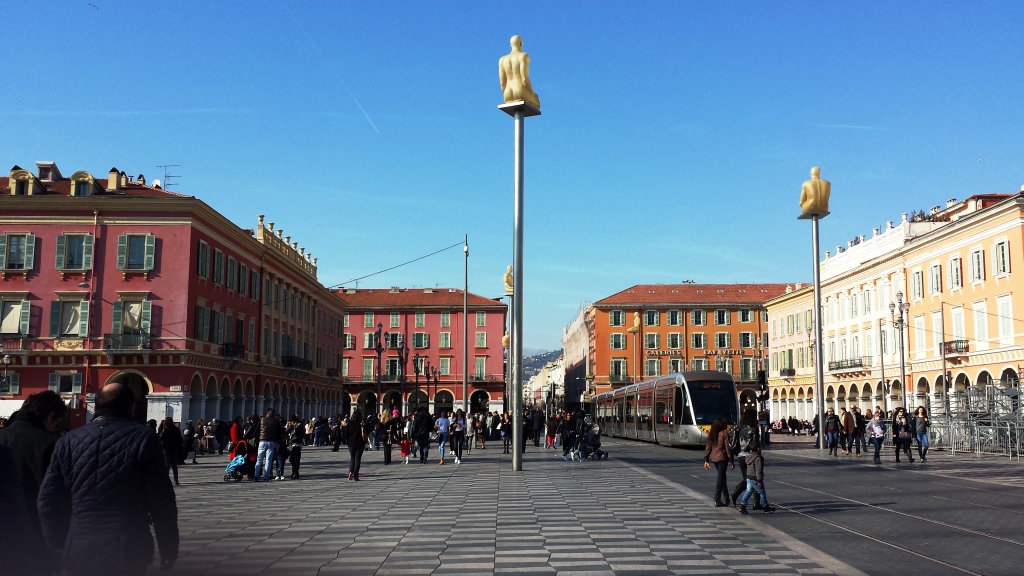
As you head south, the shops and the avenue in general will get progressively more upmarket and about 1 km from the train station, you will get to Place Massena, a beautiful square surrounded by red Italianate facades and some bizarre post-modern sculptures. This square, which is criss-crossed by trams, is really the nerve centre of the city and from here you have various options about what to see next.

Plac Massena, also recently renovated with a new tram line, snazzy paving and bizarre humanoid sculptures sitting on poles.

-          If you head straight across Place Massena, you will quickly get to the waterfront, with the Promenade des Anglais, the world-famous boulevard that stretches for 7 kilometres along the Baie des Anges between the port of Nice on the eastern side and Nice airport at its western tip.

The famous Promenade des Anglais in Nice

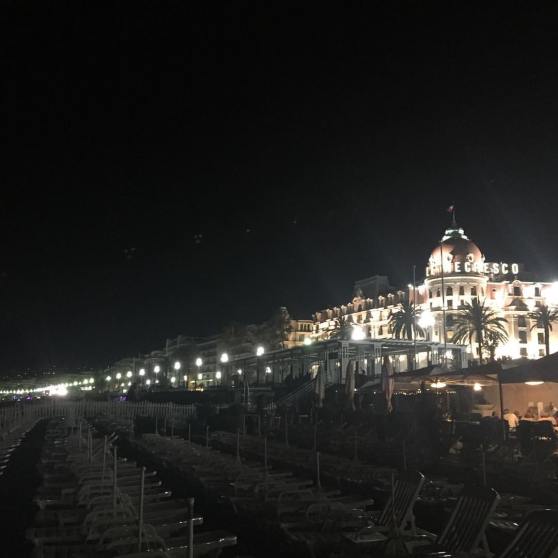
It’s a great place to wander along, cycle or roller-blade with the most interesting section being between the eastern tip (near the port, although strictly-speaking, this stretch is called the Quai des Etats Unis) and the Negresco hotel. Here is a link to one of the more conveniently located stores where you can rent some outdoor equipment (unfortunately only in French). You will be able to admire some of the beautiful Belle Epoque architecture of the top-end hotels (and also some of the inevitable 1960s eyesores, if you happen to be into that sort of thing) and also have a small walk through the charming Jardin Albert 1er. Alternatively, you can just sit on one of the blue chairs which are made available and enjoy the view of the Mediterranean sea. The beach is also an option as the blue water is very appealing in the summer and generally pretty clean; just don’t expect any tropical white sand – the beach in Nice is full of large pebbles! Also, given that most of the beach is public, watch your belongings carefully and don’t bring anything precious along.

The public beach in Nice - not exactly the fine white sand of the Maldives but the water is nice, warm in the summer and relatively clean!

-          Turning right from Place Massena, there is a rather busy pedestrian district with souvenir shops, snack bars, coffee shops (not of the Dutch variety) and some rather touristy restaurants which is pleasant to walk around but nothing too much to write home about – mainly a good place to buy your French Riviera mug, t-shirt or fridge magnet on a Sunday if everywhere else is shut.

Nice's pedestrian district, a good place to buy souvenirs if everything else is shut on a Sunday...

-          Turning left from Place Massena, you will head into the medieval old town, Vieux Nice, where the city started off. This is a rather large triangle separated by the Paillon river (buried underground) to the north, the Baie des Anges to the south and the Castle hill to the east. The best thing to do there is to wander around the narrow alleyways and soak in the traditional baroque atmosphere, best done in the early morning before the hordes of tourists have arrived. Main spots to visit are the Cours Saleya (a wide street parallel to the waterfront with plenty of restaurants and where there is a market every morning), Place Rossetti, which is the main square and the various Baroque churches hidden in the streets.

A glimpse of Old Nice, Place Rossetti.

Old Nice also a decent place to have lunch or dinner, with some wonderful gems where you can sample some of the traditional Niçois cuisine, as long as you know where to go and where to avoid – as always there are tourist traps… Can’t really say which, but generally places with a large laminated menu in 4 or 5 different languages are to be avoided, it’s just a question of common sense. For more information, please check out my walking tour of Old Nice with a lot more details on this beautiful part of town and some recommended addresses.

-          Afterwards, you can just head north and enjoy the view from the top of the Castle Hill that dominates most of the Nice waterfront. Despite its name, you won’t find a castle on top, as it was flattened by the French during a siege early in the 18th century.

The Bellanda Tower and Castle Hill, viewed from the waterfront

However, there’s a very pleasant park on top and some wonderful views over the whole city, especially from the waterfall that is visible from the waterfront. If you want to do some exercise, you can always walk to the top (it’s not that difficult as long as you’re reasonably mobile) but there is also a free air-conditioned lift that takes you up from the bottom of the hill near the waterfront, always useful in the summer. Once you get to the top, you’ll enjoy a splendid view towards the west along the whole Baie des Anges towards the airport, the Cape of Antibes and the Southern Alps behind (see the photo at the top of this article to get an idea) – on a clear day, you’ll be able to see the Esterel mountain range and the Gulf of Saint Tropez. The view eastwards isn’t bad either, over the port of Nice, which was at the heart of the ancient Greek settlement (which was known at the time as “Nikaia”).

Another view of Castle Hill, taken from the hills north of Nice. From this angle, it looks a bit like the Acropolis in Athens - the old town is to the right and Port Lympia is to the left.

-          You can walk down the opposite side of Castle Hill and have a drink on the port (also known as Port Lympia), which has just been completely redesigned and become much more pedestrian-friendly. From there, just hop on a tram from the nearby Place Garibaldi which will take you back past the old town, through Place Massena and up avenue Jean Medecin towards the train station.

-          If you still have energy, you can take a bus to the peaceful and beautiful neighbourhood of Cimiez to visit the monastery, the Roman arenas, the olive grove and the Matisse museum, whilst enjoying the opulent Belle Epoque architecture. For more information, please see the article dedicated to this part of town.

-          Finally, for museum and culture buffs, there is a huge choice in addition to the Matisse museum in Cimiez that I just mentioned: also note that access to all public museums in Nice is now free. The main ones are the Musée Massena (with an art collection set in a beautiful Belle Epoque villa by the waterfront), the MAMAC (a very modern and very large contemporary art museum with stunning views from the roof garden over Old Nice) and the Beaux Arts museum (another art collection), a bit further away. Amongst the main private museums (therefore with an entrance fee) is the Marc Chagall museum on the way up to Cimiez, which is probably only worth it if you’re a fan of his.

I hope that all this will have convinced that Nice is well worth a visit and is a beautiful and vibrant city in its own right. As always, if you find out any other tips or find any inaccurate information, please feel free to let me know.

Getting there:

-          By train: Nice is at the centre of the main railway line between Cannes and Ventimiglia, so is easily accessible from both directions. It takes about 40 minutes to get there from Cannes and 25 minutes from Monaco. Nice has three railway stations: St Augustin, Nice Ville and Nice Riquier. Nice Ville is the most central and the one I refer to in this article.

-          By bus: all inter-urban bus lines on the French Riviera only cost 1€ regardless of the distance covered. Line 100 follows the coastline east towards Monaco and Menton, whilst line 200 heads west towards Antibes and Cannes. Bear in mind that buses tend to be packed because they are so cheap and that there is plenty of traffic during rush hour so this option is less convenient than it appears on paper. The central bus station in Nice (close to the old town and the modern art museum) is currently being rebuilt so you’ll need to consult this website to see on which street exactly to take the bus (it depends on the line you’re taking).

-          By car: Nice is a large city which means that it’s hard to park and that underground parking is extortionate, especially during the day. I’d therefore advise you to take the train if possible. If you really need to take your car in the evenings, bear in mind that the public car park underneath Place Massena has a reduced rate from 8pm onwards, but the car parks inside the old town (especially the Cours Saleya parking lot underneath the flower market) do not.

Getting around Nice

There is an extensive and very reasonably priced bus network, which has recently been complemented by a tram line, all at 1€ for a single journey. For the trams, you need to buy your ticket at the bus stop before boarding and then validate your ticket as soon as you get on. As with everywhere, watch your pockets carefully in crowded spaces. For more information on bus and tram routes, consult the urban transport website.

A walk around the historical neighbourhood of Cimiez in Nice

22 Sep

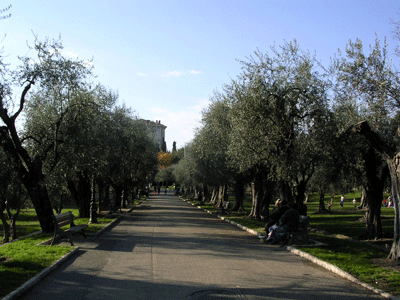
The lovely park of Cimiez, full of olive trees and nostalgia from the Jazz Festival that used to take place here

Cimiez may be slightly off the main tourist trail but is definitely one of my favourite neighbourhoods in Nice, located about 2 kms north-east of the Nice Ville train station on top of a small hill.  This pleasant and upper-class residential district used to be the Roman settlement of Cemenelum before becoming in the late 19th century one of the favourite haunts of the rich and famous, notably British aristocrats, explaining the sumptuous Belle Epoque architecture.  Queen Victoria was a regular at the Regina Palace Hotel, which still dominates the hill with its magnificent 200m wide façade, even though it is no longer a hotel, hence her statue at the entrance of the neighbourhood.  Attractions include the Matisse Museum, the Roman amphitheatre and archaeology museum, a neo-Palatine Monastery and an olive-filled park where the famous Nice Jazz Festival used to take place every July until it sold out, became too commercial and was moved to the centre of Nice.

How to get there

Cimiez is accessible by bus line 15 (see timetables) from Place Massena in the city centre. Otherwise it is a pleasant and gentle uphill 20-minute walk from the railway station, through some lovely Belle Epoque architecture up Boulevard de Cimiez.

What to see

-          The Matisse Museum  is located in a beautiful 17th century mansion, with a more architecturally-debatable modern wing built underground next door.

The Matisse museum in Nice, housing a large amount of the artist's collection in the lovely setting of the park of Cimiez

Henri Matisse lived in Nice from 1917 until his death in 1954 (his apartments and workshop were actually in the nearby Regina Palace), so this museum comprises the major aspects of his work: sculptures, paintings, as well as the blueprints for the chapel he built in 1953 in Vence.

-          The Franciscan Monastery, on the opposite side of the park, was built in the XVIth century in a rather extravagant neo-Byzantine style.  Beautiful architecture but the main draw is the monastery grounds, with a splendid garden offering fantastic views over the city centre, the eastern hills of Nice and the Paillon river valley: this is where you can see how the city is completely encircled by mountains.  

The Monastery of Cimiez, with a lovely garden round the back

-          The Roman amphitheatre and ruins are presented in the nearby archaeology museum, which, like most of the other museums in Nice, is free to access.  The arena also used to be the location of concerts during the jazz festival and one of my major memories is of seeing the American trumpeter Roy Hargrove and the RH Factor at sunset in July 2003: the sweet blend of jazz and soul was totally appropriate for the setting.

The ruins of the Roman amphitheatre in Cimiez

 
-          A walk around the neighbourhood, to sample to architecture, notably Boulevard de Cimiez and Avenue de Arènes de Cimiez.  For an alternative return route, bring a map and turn right off Boulevard de Cimiez into Avenue du Prince de Galles, and walk through the elegant gate of the university campus in the beautiful Parc de Valrose which will bring you back down to the city centre.

Follow

Get every new post delivered to your Inbox.

Join 35 other followers